Getting to Bergen by ferry
Yes, it can be done — and Bergen is one of the few Norwegian cities where you land straight from abroad, without having driven across the country first. A single line makes it possible: Hirtshals, at the northern tip of Denmark, one night at sea, and you dock at the foot of the mountains in the early afternoon.
This page answers three questions in order: which boat goes there and what it costs, which other sailings leave Bergen once you are on the spot, and what a week in the fjords looks like when you arrive this way.
Which ferries go to Bergen?
Hirtshals to Bergen, the only international line
Fjord Line runs the crossing all year, one sailing a day in each direction. Count seventeen to eighteen hours at sea: the second longest crossing on this site, after Kiel to Oslo. You board in the evening at Hirtshals, sleep on board and land in Bergen in the early afternoon.
On price, the operator's booking engine asks 320 to 575 euros for two people, a car and the cheapest two-berth cabin. It is a dynamic fare that depends on the date and on how far ahead you book: take it as an order of magnitude, not a promise. One thing not to discover the night before: with a single daily sailing, missing the boat costs twenty-four hours.
Today's sailing times, the fare scale by vehicle length and frequently asked questions on the route page. See the route page →
Compare prices and book →When it is genuinely worth it
- To arrive straight in the fjords. From Kristiansand or Oslo it is another seven to eight hours' drive to Bergen. Here you land in the west, and the Hardangerfjord starts an hour away.
- To avoid two days of driving in a row. The night on board replaces a hotel stop and a day at the wheel. You get the journey back instead of enduring it.
- For the landscape. The approach to Bergen from the sea, threading between the islands, is part of the trip rather than a stretch to be survived.
- For anyone not driving. The ship takes foot passengers, and Bergen is a city you can see without a car: the old harbour, the funicular and the port are minutes apart.
And if you are coming by road
No other ferry goes to Bergen as such, but two crossings sit on the road depending on where you come from. Neither is booked — first come, first aboard — and the toll is charged automatically by number plate, without stopping.
Working up the coast with your own car: the coastal express
Bergen is also the departure port of the coastal express, which runs up to Kirkenes calling at thirty-four ports. It is not quite a ferry — you buy a port-to-port ticket, not a crossing — but you can take a car on board, and the rules differ by operator.
Two companies share the line, and only one lets you take the car off along the way
| Operator | Where the car can board and land | Restrictions | Ships |
|---|---|---|---|
| Hurtigruten | at every regular port of call, except the Geirangerfjord and Hjorundfjord anchorages | size limits vary by ship, from 5.40 x 2.30 m to 6.40 x 2.40 m | 7 ships; the three signature vessels (Trollfjord, Finnmarken, Midnatsol) take no cars |
| Havila | Bergen to Kirkenes end to end only — the car cannot be landed en route | electric, hybrid and hydrogen vehicles refused; 5.10 x 2.25 x 2.10 m maximum | 4 ships, 9 cars each, with no access to the vehicle during the voyage |
The difference decides everything if the plan was to do part of the coast by sea and the rest by road: only Hurtigruten lets you land the car at an intermediate port. With Havila it goes on in Bergen and comes off in Kirkenes.
Second point, and a surprising one in the country with the world's highest share of electric cars: Havila refuses electric, hybrid and hydrogen vehicles on fire-risk grounds. Hurtigruten states nothing of the kind on its vehicle page, which is not the same as permission: check with the operator before booking.
Tickets are sold port to port, in both directions, with a cabin optional below 23 hours of travel and compulsory above. Meals are not included. Port-to-port tickets with Hurtigruten and Havila's vehicle rules.
Other boat trips from Bergen
Once you are there, the region is still best seen from the water. Three ways of doing it, from the most practical to the most touristic.
Bergen to Flam, the express boat that takes no cars
This is a scheduled boat, not a cruise: Norled links Bergen to the head of the Sognefjord in five hours, carrying nothing but passengers. For anyone travelling without a car it is the simplest way to reach Flam and its railway — and for anyone with one, it is a one-way trip to plan around, since the vehicle stays in Bergen. Times and prices compare on Direct Ferries.
Compare prices and book →The Mostraumen cruise, the half-day classic
 EXCURSION Original cruise
Running from Bergen for more than 15 years, this 3h30 cruise on a modern catamaran explores the Osterfjord and the narrow Mostraumen strait. The captain edges up to the curtain of water of a waterfall; on board, cross buns and waffles from a Bergen bakery.
- 3h30 round trip · Bryggen (UNESCO) at departure · open deck + panoramic lounge
- Osterfjord + Mostraumen strait + waterfall right by the boat + sea eagles
- ⚠️ Audio guide only (no live guide) · pastries for sale on board
And also
The Rosendal cruise through the Hardangerfjord in summer, the Fyksesund by RIB from Norheimsund, and the long day that strings together the Naeroyfjord, the Flam railway and the Viking village — the priciest of the list, but the one that packs the most Norway into a single outing.
Where to stay in Bergen on arrival
The ship docks in the early afternoon: no need to hunt for a bed at the last minute. Two well-rated addresses, and all the others just below.
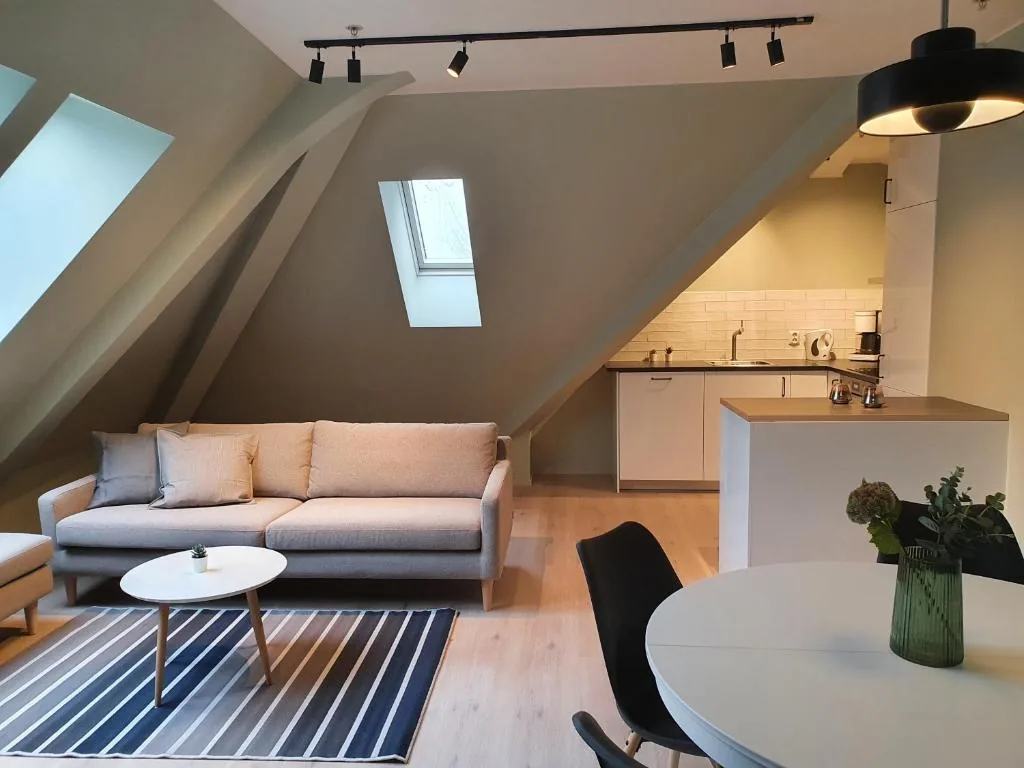
Apartments on an old street in central Bergen, 250 m from the station.
- Large apartments with a fitted kitchen
- Bryggen and the cathedral within walking distance
- Few basics provided on arrival
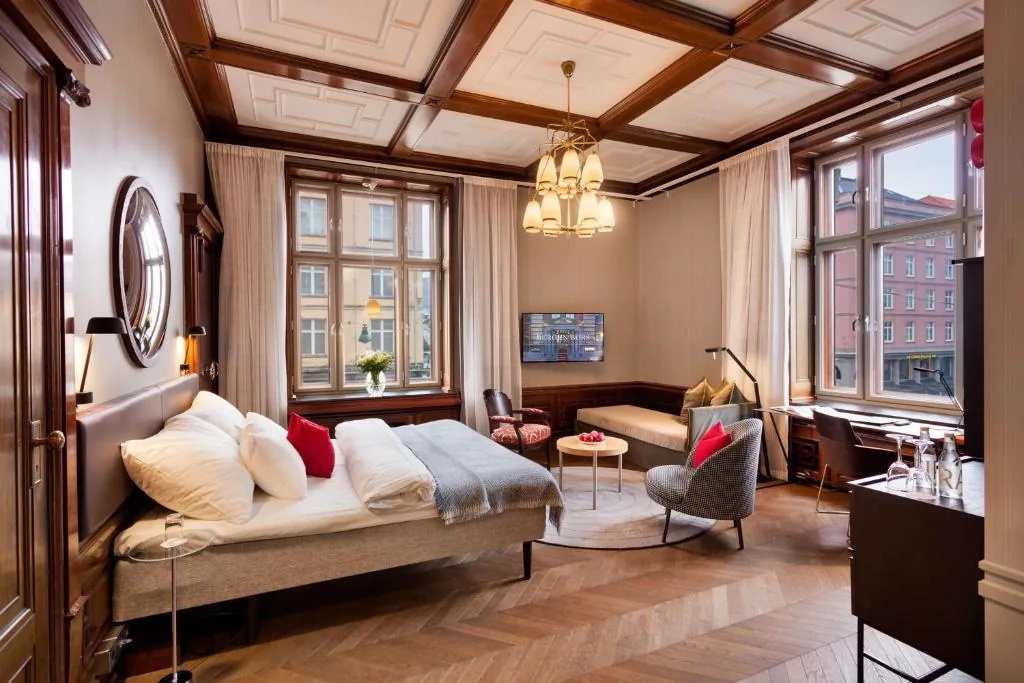
Bergen's former stock exchange, now a five-star hotel on the Vågsallmenningen.
- Fish market and Bryggen a minute away
- Breakfast included and widely praised
- Small rooms, and street noise in some of them
What to do in Bergen
- Bryggen, the Hanseatic wharf and its wooden facades on the UNESCO list. Early in the morning, before the groups, the alleys behind the facades are worth more than the postcard.
- The Floyen funicular, seven minutes to gain height over the city and the fjord, with trails at the top for anyone who would rather walk down. The other summit, Ulriken, is reached by cable car and looks down from higher up.
- The neighbourhoods, finally, which are the real pleasure of Bergen: Nordnes and Nostet with their painted wooden houses, away from the visitor flow.
For the detail — museums, addresses, how long each thing takes — the full city guide is on my blog: Visiting Bergen: what to do in a few days
The guided walk, if you only have one day
Two hours on foot with a guide is the best time-to-understanding ratio when you come off the boat and leave again the next day.
 EXCURSION 🚶 Walking tour · 2 hrs · small group · local guide
Two hours on foot with a licensed guide who lives in Bergen all year round: first the history (Bergenhus, Bryggen UNESCO, the Hanseatic League, St Mary's Church), then the cobbled lanes behind Bryggen, with local life, house prices, the guide's favourite cafés and neighbourhood cats.
- Licensed local guide (year-round resident) · group limit respected
- Tour runs whatever the weather · restaurant and bar tips at the end
- ⚠️ Guide in EN/DE only · uneven cobbles · some uphill sections · not suitable for reduced mobility
A week around Bergen
If you arrive with the car, here is the loop in broad strokes. It comes from the detailed route I wrote on my blog, and it crosses three ferries whose timetables you will find right here.
- Two days in Bergen: the city on foot, Bryggen, the funicular, the wooden quarters.
- A day on the water: the Mostraumen cruise in the morning, the Fantoft stave church in the afternoon.
- Towards the Sognefjord: the Tvindefossen waterfall, the old Stalheimskleiva road, the Hopperstad church at Vik, then the ferry from Vangsnes to reach Fjaerland and its glacier.
- The valley of the churches: Kaupanger, Laerdal and the Borgund stave church, the Fodnes to Mannheller ferry, and the climb to the Stegastein viewpoint above Aurland.
- The Naeroyfjord: the crossing between Gudvangen and Kaupanger, the narrowest arm of the Norwegian fjords, and a stop at Undredal for its goat cheese.
- The Flam railway to finish, up to Myrdal — and back down by bike for anyone with the legs.
The ferries on the loop : Vangsnes–Dragsvik · Fodnes–Mannheller · Gudvangen–Kaupanger