Ferry in Copenhagen: which lines, and when the bridge wins
Copenhagen is a city you never reach in a straight line. Denmark is an archipelago: every route into the capital, and every route leaving it northwards, poses the same question — sea or asphalt, ferry ticket or bridge toll.
The answer is not always the obvious one. Only one ferry leaves Copenhagen, the Oslo boat, and it crosses overnight. Two others, German, land two hours short of the city. And two toll bridges, the Great Belt and the Oresund, do exactly the same job for a price that is anything but incidental. Here are the three lines, then the reckoning, with figures.
The line out of Copenhagen
Copenhagen to Oslo, one night between two capitals
One sailing a day, at 16:30, and seventeen and a half hours at sea: you leave the harbour in late afternoon, work up the Oresund at sunset, and wake in the Oslofjord, the final approach threading between the islands to the Akershus quay in central Oslo. 125 to 410 euros depending on season and cabin, vehicle included.
This is not a crossing, it is a stage. The cabin replaces a hotel night and a day of driving: by road, Oslo is about 610 km from Copenhagen, a good seven hours over the Oresund bridge and the Swedish E6. Once the toll, the fuel and the evening stop are added up, the price gap with the ship melts — and the ship hands you back the day.
Today's sailing times, the fare scale by vehicle length and frequently asked questions on the route page. See the route page →
Compare prices and book →When this line is the right one
- If you are driving up from Germany or the Netherlands. Copenhagen is on the way: boarding here rather than crossing the whole of Sweden turns the second day of driving into a night of sleep.
- If you want to arrive from the sea. Entering the Oslofjord at first light is worth the early start, and the ship docks in town, not in a port zone twenty kilometres out.
- If you travel without a car. The line works well on foot or by bike: both terminals are urban, and the passenger-only fare stays modest.
- If you are not in a hurry. Seventeen and a half hours is a whole day. If Oslo has to be reached that evening, the road through Sweden wins.
The two ferries that bring you to Copenhagen
No ferry links the continent directly to Copenhagen: the two German lines land on the southern islands, about two hours of motorway from the capital. Puttgarden to Rodby is one of the busiest ferry routes in Europe and runs as a continuous shuttle, day and night; Rostock to Gedser serves those coming up via Berlin rather than Hamburg.
Ferry or bridge? The reckoning, with figures
The two Danish bridges are not a free alternative to the boat: on their own, the Great Belt and the Oresund cost as much as a ferry ticket. Here are the two decisions that genuinely arise in Copenhagen, at the 2026 rates published by the operators.
Coming from Germany: the Puttgarden ferry or the Great Belt bridge
| Route from Hamburg | Distance | Door to door | Cost of the crossing |
|---|---|---|---|
| By ferry Puttgarden to Rodby | about 340 km | about 4h45, of which 45 min at sea | 48 to 67 euros for the ticket |
| Through Jutland and the Great Belt bridge | about 490 km | about 5h non-stop | 235 DKK (~31 euros) at the booth, 205 DKK in the express lane |
On paper it is a draw: a handful of minutes between them and a crossing cost of the same order. Three things decide it. A hundred and fifty kilometres less by ferry, worth some fifteen euros of fuel and as much wear; forty-five minutes on your feet instead of forty-five at the wheel, which counts for something in the middle of a long day; and a ticket price that moves, while the bridge toll does not.
In practice: booked ahead, the ferry undercuts the bridge and wins on every count. Bought at the booth on an August Friday it doubles, and the Jutland road becomes the right answer again. Worth knowing: since 1 January 2026 the reduced Great Belt rate (205 DKK) no longer requires a subscription — a BroBizz tag or number-plate payment is enough. In time the Fehmarnbelt tunnel, announced for 2029, will settle the question altogether by putting ten minutes of road between Puttgarden and Rodby.
Heading on to Norway: the night boat or the Oresund bridge
| Copenhagen to Oslo | Distance | Time | Cost of the crossing |
|---|---|---|---|
| By ferry Copenhagen to Oslo | — | 17h30, one night on board | 125 to 410 euros, vehicle and cabin included |
| Over the Oresund bridge, then the E6 | about 610 km | about 7h driving | 470 DKK (~63 euros), or 182 DKK with OresundGO |
| Via the Helsingor ferry, then the E6 | about 565 km | about 7h, of which 20 min at sea | the boat ticket, no toll |
The Oresund bridge is the reflex, and it is the most expensive passage of the whole trip: 470 DKK at the booth, some sixty euros for sixteen kilometres. The OresundGO subscription (370 DKK a year) brings the crossing down to 182 DKK, and it already pays for itself on a return trip, provided you sign up before leaving.
The Helsingor to Helsingborg ferry is the option nobody works out. Forty-five kilometres north of Copenhagen, twenty minutes at sea, up to some fifty sailings a day — and it shortens the drive instead of lengthening it, because the bridge forces a detour down to Malmo before heading north again. With two or three people in the car it often comes in below the toll.
As for the Oslo boat, it plays in another category: it does not replace a toll, it replaces a day of driving and a hotel night. Compare it by adding everything up — fuel, toll, evening stop — and not by the ticket price alone.
Where to stay in Copenhagen before boarding
The Oslo boat leaves at 16:30: if you are arriving from Germany the same day, better to have slept in town than on a motorway rest area. Two well-rated addresses, and the rest of the choice just below.

Studios with a kitchenette in Nordhavn, the district built on Copenhagen's former container port, a step away from the water.
- Sea view from some studios, gym, laundry on every floor
- Reception open day and night, staff rated 9.5 out of 10
- Orientkaj metro 800 m away, dogs welcome, swimming spots all around
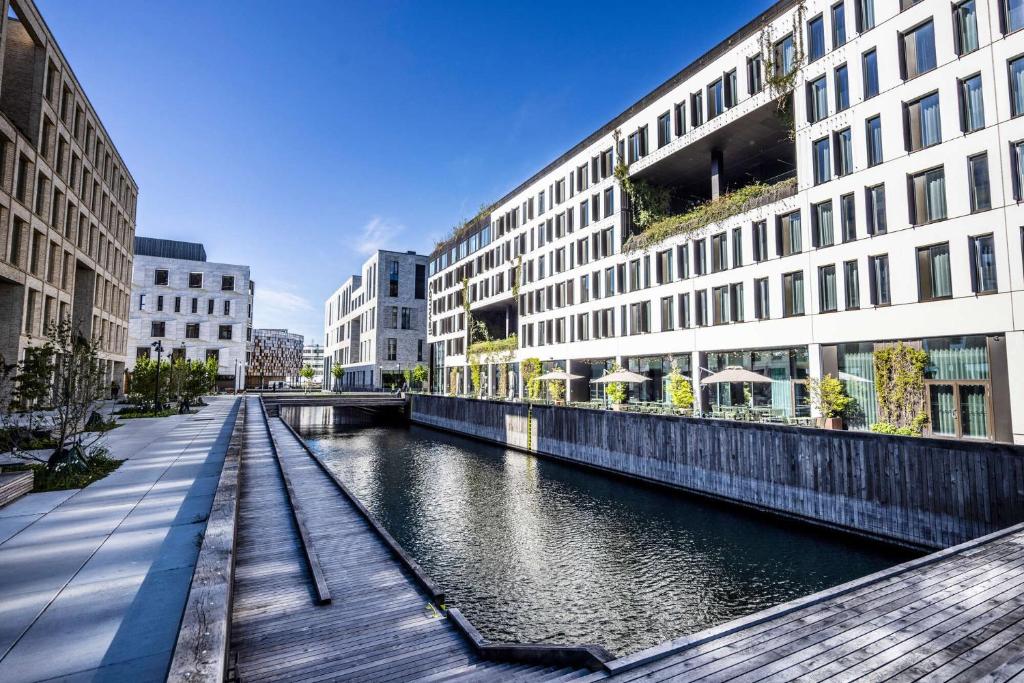
A tower in the new Nordhavn district, at the northern end of Copenhagen's harbour.
- Recent rooms, fitness room and restaurant
- Breakfast included
- Breakfast room often crowded · metro 1.9 km away
What to do in Copenhagen
- Leave the car and take a bike. Copenhagen is flat, entirely cyclable, and the essentials fit within a three-kilometre radius: it is the European city where a car is least use.
- Nyhavn and the canals, by boat for preference. The inner harbour, the Opera, the Little Mermaid and Christianshavn read better from the water, and the loop fits inside an hour.
- Refshaleoen and Christiania, on the far bank: former shipyards turned street-food halls, with a floating sauna and harbour baths as soon as the thermometer allows.
- Rosenborg and the crown jewels, or the National Museum if the weather turns — both walkable from the centre.
For the rest of the journey on to Norway, every line compared in a single article: Taking the ferry to Norway: lines, prices, booking
Tivoli, and why to buy the ticket before you go
The park sits in the middle of town, at the foot of the station: you will almost certainly walk past it. Booking online skips the ticket-office queue — and it is worth knowing exactly what the ticket covers. This one gives entry, the gardens and the concerts; if the rides are part of the plan, the combined ticket with unlimited rides saves paying for each attraction on the spot.
 EXCURSION 🎡 Opened in 1843 · at the foot of the central station
The second oldest amusement park in the world, opened in 1843 and set in the middle of town, at the foot of the central station. Landscaped gardens, concert stages, some thirty restaurants: people come as much to walk through it in the evening, when the lights go on, as for the rides.
- Skip-the-line entry to the park, valid all day
- Gardens, concerts and restaurants included
- ⚠️ The rides are NOT included — the Ride Pass is bought separately