Getting to Oslo by ferry
Oslo is the Norwegian city best served by sea: two international lines lead there, both overnight, both into the city centre. You do not land in a port zone twenty kilometres out — you land within walking distance of the Opera House.
The last hour of the crossing is worth seeing: the ship works its way up the Oslofjord between islands and wooden houses, and the city arrives gently. This page compares the two lines, then says what happens once you are ashore.
Which ferries go to Oslo?
Kiel to Oslo, the German line
Color Line runs it all year, one sailing a day in each direction, twenty hours at sea — the longest crossing on this site. The ship leaves in the early afternoon and arrives the next morning: two nights on board for a return trip, with a full day at sea in the middle.
It is also the most expensive: 540 to 835 euros for two people, a car and the cheapest cabin. It earns its place for anyone coming from southern Germany, Austria or Switzerland, because it removes the whole of Denmark and both of its toll bridges.
Today's sailing times, the fare scale by vehicle length and frequently asked questions on the route page. See the route page →
Compare prices and book →Copenhagen to Oslo, the cheaper one
Seventeen and a half hours, one sailing a day each way, and a price that starts at 125 euros against 540 for Kiel. The gap is not in the cabin but in the car, charged three times less here.
The ship belongs to Go Nordic Cruiseline, which took the line over from DFDS. For anyone crossing Denmark anyway or coming down from Sweden, the detour through Copenhagen happens almost without noticing.
Today's sailing times, the fare scale by vehicle length and frequently asked questions on the route page. See the route page →
Compare prices and book →When it is genuinely worth it
- To arrive in the centre. Both quays are in Oslo itself, minutes from the historic core. No transfer, no shuttle, no compulsory rental car.
- To bring the car without driving it for two days. The night on board replaces a hotel stop and eight hundred kilometres of motorway.
- For the run up the Oslofjord. An hour threading between the islands before docking, at daybreak: there is no other way to watch the city arrive like that.
- For anyone travelling without a car. Both lines take foot passengers, and Oslo is covered by metro and tram.
And if you are coming by road
Two ferries shorten the drive depending on where you come from: the first crosses the Oslofjord and saves going round it through the city and its traffic, the second crosses the Drammensfjord in five minutes, further west. Neither is booked, and the toll is charged automatically by number plate.
Boat trips from Oslo
The Oslofjord begins at the foot of the Opera House, and it is by far the best way to see the city. Three formats, from the silent electric boat to a day of island hopping.
The silent Oslofjord cruise
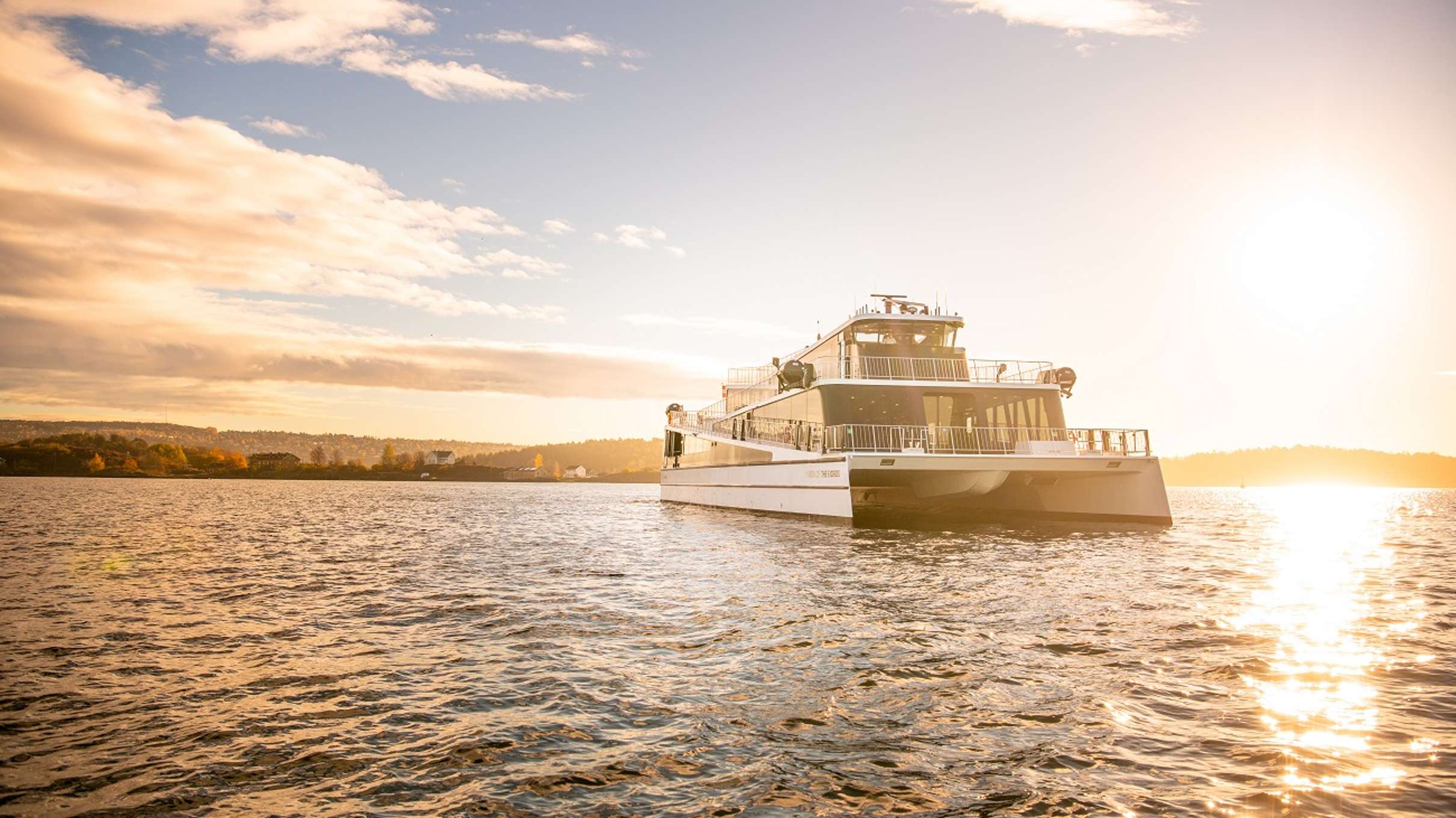 EXCURSION 🇫🇷 French audio
A noiseless cruise on the Oslofjord, with the capital seen from the water, a comfortable panoramic lounge and an open deck for photos. A welcome break after a day walking around town: sit back and let the audio guide tell the story through your headphones.
- 100% electric boat · Wi-Fi + food and drinks on board
- Audio guide via app in French (Voice of Norway, download beforehand)
- Passes Akershus · Aker Brygge · Bygdøy · Oslo Opera House
And also
The narrated catamaran cruise for anyone who wants the story with the scenery, and the guided island hopping in summer, which lands on Hovedoya and Lindoya — where the locals go swimming, twenty minutes from the centre.
Where to stay in Oslo on arrival
Both ships dock in the morning: the room will not be ready, but luggage can be left. Two well-rated addresses, with the link to all the others just below.
 OUR FAVOURITE
The former head office of Oslo's electricity company, reopened as an art deco grand hotel after six years of work, in the residential district of Frogner.
- Rooftop pool, spa and restored public baths
- Seven restaurants and bars, private cinema
- The decor and the breakfast come up in every review

A colourful lifestyle hotel dropped into a district still being rebuilt, north-east of the city.
- Panoramic rooftop and arcade lounge
- Spacious rooms and breakfast often mentioned
- 6 km from the centre, well served by metro
What to do in Oslo
- The Opera House, whose roof you walk up — it is a public square in white marble, not a paying balcony, and the view over the fjord costs nothing.
- The Bygdoy museums, on the peninsula opposite: the Fram, the best preserved polar ship in the world, and the Kon-Tiki. You get there by boat from the city hall, which makes an outing on the water in itself.
- Vigeland park and Grunerlokka, the first for its two hundred open-air sculptures, the second for the cafes and second-hand shops — this is where Oslo stops being an administrative capital.
The full city guide — museums, neighbourhoods, how long each thing takes — is on my blog: What to do in Oslo: a guide for a weekend or more
The guided walk, to make sense of the city in two hours
Useful on arrival day, when the room is not ready and half a day lies ahead with no obvious starting point.
 EXCURSION 🚶 Walking Oslo · 2 hrs · local Scandinavian guide
Over 2 hrs on foot in central Oslo, a local Scandinavian guide (Nordic Freedom Tours, since 2015) covers the Royal Palace, Karl Johans gate, Akershus Fortress, the Opera House on the fjord and City Hall, with anecdotes on the royal family, the Nobel Peace Prize and Oslo today.
- Local Scandinavian guide · comfortable pace · plenty of contemporary anecdotes
- Very reasonable price for Norway · ideal on day 1 to get your bearings
- ⚠️ English-speaking guide only · 2 hrs standing outdoors · runs whatever the weather